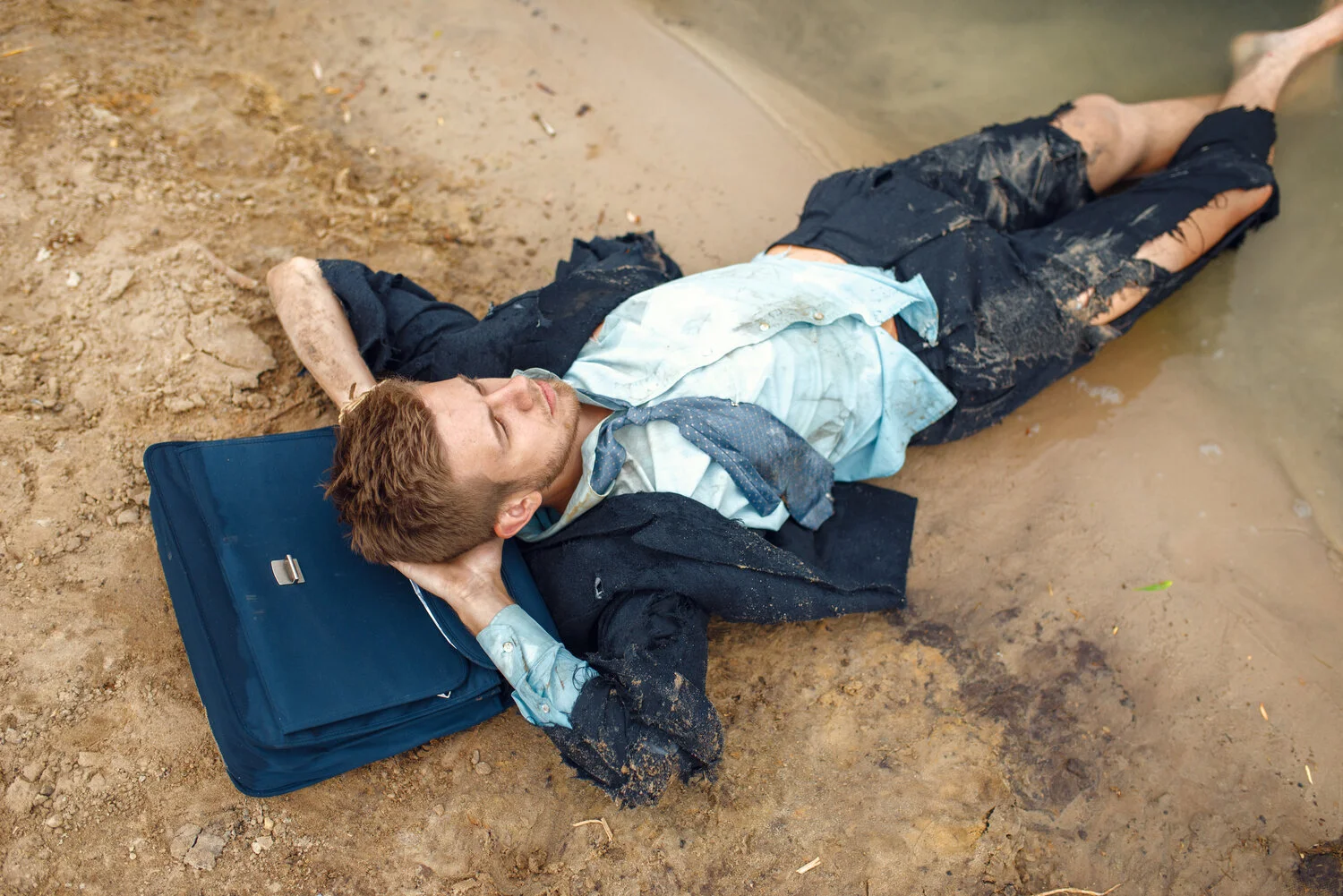
This chapter resonates with Jesus’ teaching: “Live by the sword, die by the sword.” (Matthew 26:52). It is also one of several places where we see a sort of healthy “selfishness” at play. We’re referring here to the possible influence of the school of Yang Chu, who taught a kind of ethical egoism. This isn’t the self-destructive selfishness of narcissists and gluttons, but rather an emphasis on personal health as foundational for one’s ability to care for others. As they say on commercial flights: In the case of an emergency cabin decompression first put on your own oxygen mask before assisting others.
Read MoreLao Tzu emphasizes value of carving out empty space in one's life for centering, creativity, and preparation for action. We discuss this, and the concept of Sabbath in the Jewish and Christian traditions. The chapters discussed are 11, 73 and 12.
Read MoreThe concept of wu wei is practically and clearly stated in this chapter. Again, this principle of acting by not acting isn’t about disregarding one’s duties, nor is it about being a pushover. It’s about letting the natural forces of the world flow as they flow without arrogantly assuming we can step in and control the flow through force.
Read MoreLao Tzu clearly favors the feminine principle, the negative space, and the faith of a child. This last preference is especially resonant with the teachings of Jesus about being childlike. Over and over, we’ve been pointing to teachings from Jesus but not to create a syncretistic new way of thinking. Instead we are showing how Jesus and Lao Tzu often were teaching similar things. This has little to do with what is known as doctrine in Christian theological circles, however.
Read MoreYour ego always exists for something or someone else. With ego, you're giving away your power & become a slave to them or that thing, since you don’t have your own agency at that point. So let your ego sit this one out so you can rediscover your true self & nurture it.
Read MoreSome falsely assume that the Taosurfer is free from all material attachments. While it is true that Lao Tzu’s philosophy embraces the value of minimalism and is uninterested in accumulating excessive stuff, it remains aware of bodily needs and the essential tools necessary for life in this world.
Read MoreSo, the Tao is sublime.
Heaven, earth, and humanity
are also sublime.
See how there are four sublime realities
in the universe, and humanity
is included?
The sage learns that seeking goodness in the world isn't so much a matter of willpower as much as it the proper tuning of the senses to taste and see that good is good.
Read MoreHere, Jeff isn’t saying he’s sorry for what he said in Part 1, rather he’s providing an apologia for his perspective on academic freedom within church related schools and universities. Check out the previous part, at least the first ten minutes, before heading to this part, which is more technical and deals especially with the epistemology of William of Ockham and it’s resonance with Lutheran epistemology later on.
Read MorePart one of Jeff’s lecture and discussion of agency, epistemology, and academic liberty within church related schools and universities.
Read MoreStorms blow across hills in the morning, then give way to stillness. Rain bursts from thunderclouds in the afternoon, then the evening sky enjoys silence.
Read MoreFeeling a deep love for all living beings, the sage is uninterested in besting them at a verbal fight. If others ask for help finding truth, the sage is generous and obliging. If they want to feel superior, the sage is generous and obliging. It’s not that she’s a pushover; it’s that they can’t harm her. She’s not playing her enemies’ games so they can’t possibly win.
Read MoreHeather Choate Davis is an author and has created a new album with her network of musical friends called Life in the Key of God. We talk about how the Christian contemplative tradition and the recovery of the biblical concept of Sophia (divine wisdom) can help us protect our noggins and bring healing to our culture and churches. Several beautiful tracks are previewed.
Read MoreThe sixteenth century Calvinists argued that the finite cannot contain the infinite. Their context was Holy Communion and the nature of Jesus Christ. Without recourse to special revelation from the heavens, Lao Tzu reflects on how going close up to reality we find that there’s an infinite depth to even the smallest of things.
Read MoreLao Tzu wasn’t experiencing persecution from those in the system; they just couldn’t understand him. Therefore, freedom from shallow and expensive events is liberating, not something to lament. In other words, the sage isn’t worried about getting to a better party, the sage is the epicenter of the true cosmic party. You can be too.
Read MoreA discussion of the concept of minimalism as understood by Lao Tzu, especially in chapters 59, 44, 48, and 80.
Read MoreLay down virtue signaling and legalism so everyone can recover genuine compassion and begin to really care for one another.
Losing the Tao, family relations and national stability break down, leading to chaos. Lao Tzu wasn’t a prophet predicting the future. Rather, he observed a perennial pattern we do well to heed today.
Read MoreLao Tzu had a different take on leadership than Machiavelli. This is a timely reflection for frightening times that could use a little more love.
Read MoreMicah Bournes is a poet, hip hop artist & singer. He discusses his experiences in Long Beach public schools and later a conservative Bible college, laments some of the important elements that were lacking, and offers provocative but timely reflections on ways to reimagine education and other systems of society.
Read More